
2026 Christmas Ornament
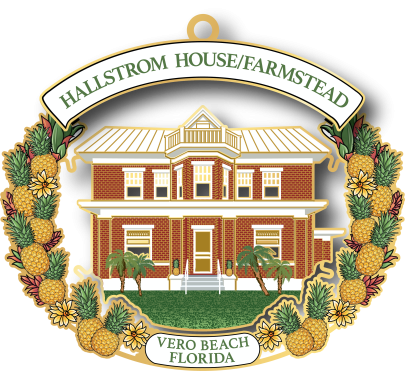
Hallstrom House
Hallstrom House Museum and Farmstead is located at 1723 Old Dixie Highway SW in Vero Beach Florida. The Hallstrom house was built in 1918 by Axel Hallstrom. Hallstrom was a prominent Swedish-American immigrant, horticulturist, and community leader who significantly shaped the agricultural history of Florida's Indian River County. The house, and surrounding five acres of land, is owned and operated as a museum by the Indian River County Historical Society (IRCHS). The IRCHS took possession of the property in July 2000. It was placed on the National Register of Historic Places in 2002.
The Hallstrom House stands upon five acres of a sloping ancient coastal sand dune, a portion covered with lush green grass. The estate is set high on the Florida Ridge amid spacious grounds with a view overlooking Old Dixie Highway. The landscape is dotted with various native and exotic plants, shrubs and trees, including a small pineapple patch and fruit trees such as pecan, fig, peach, citrus, avocado, mango and guava. Many were brought to the site and cultivated by Axel Hallstrom and his family.
The five-acre site is a portion of the original 40-acre property purchased by Axel Hallstrom in 1909 for his pineapple plantation. He expanded his land holdings in 1913 to a 160-acre plantation that later became one of the area's first citrus groves. The Main house is a two story, three bay, side-gabled building flanked on the north facade by a small flat, metal roof porch wing. On the east/main facade by a one-story flat roof portico, a two-story polygonal bay and a gable dormer with balcony. Decorative brickwork and patterned wood shingles are visible at both north and south gable ends. The Main house was built on a concrete foundation made with oyster and shell that is visible from the interior crawl space/basement.
The Hallstrom House, a stately brick home located upon the Atlantic Coastal Ridge on the west side of Old Dixie Highway in the Oslo area, is an example of the influence of the culture and the experiences of its owner and designer Axel Hallstrom of Sweden. The house stands not only as an example of exemplary architecture, but serves as testimony of a past era. The original buildings, their contents and the landscape serve as an historic document of design and craftsmanship, Florida's pineapple industry, agricultural practices, daily pioneer life, and Swedish immigrant history during the early twentieth century in Florida. Identifiable features of the house reflect Scandinavian, and prominently Swedish, craftsmanship.
Axel Hallstrom and his wife, Emely were both Swedish immigrants. In 1904, they moved from St. Paul, Minnesota when Emely, became ill. Her doctor recommended a warm climate and they moved to Florida. They had a daughter, Ruth in 1904. Sadly, Emely died in 1908, after a long illness. Axel’s sister, Johanna, moved from Chicago to help care for Ruth. Axel, Ruth, and Johanna were the only family members to ever live in the Hallstrom House.
The Hallstrom’s built a successful farming business, and were instrumental in bringing innovation and growth to the area. Axel was recognized locally and even internationally by his home country of Sweden for his contributions. He and his daughter, Ruth, loved to travel together. Today the Hallstrom House contains many artifacts and exotic and family treasures from their travels. Some of these include table china and serving instruments, ornate furniture and decorations.
Ruth also collected paintings of Floridian landscapes by the “Highwaymen”, a consortium of African-American painters. Due to racial discrimination during the times of segregation, they sold their paintings from car trunks along U.S. Highway 1 out of financial necessity. These are currently on display at the Hallstrom House Museum.
The Hallstroms were considered a wealthy and successful family, but from all accounts, were gracious, and a family who believed in supporting their community. Education and the arts also played an important part in their lives. Ruth learned to speak multiple languages, became an amateur artist, played the piano, and even was a school teacher at Orchid Island.
Ruth Hallstrom bequeathed her childhood home 5-acre parcel, and outbuildings to the Indian River County Historical Society with the purpose of preserving the house, its collections and stately grounds. The property is a living museum and education center which documents and demonstrates a bygone way of life in southern Indian River County, Florida. The collections include artifacts, photographs, paper documents, furniture and memorabilia.
The surrounding 100+ acres adjacent to the Hallstrom House were purchased and restored by Indian River County as a nature preserve, conservation area, and green space. It is appropriately named the Hallstrom Conservation Area.
Sources: Written and compiled by Kent Tamsen, Vice President of the Indian River County Historical Society Contributions and historical references provided by Ruth Stanbridge, Indian River County Historian Excerpts provided from the National Register of Historic Places, reference 02000605.


Become a Collector!


Laura Moss and Nancy Catania showing off the Gardenfest ornament (left). Merrill P. Barber's Granddaughter pictured here after purchasing the 1994 Merrill P. Barber bridge ornament (right)


Click Here to View the Ornament Gallery